Collection 03 / 04 · 12 works
Circle
These may look simple; however, the concentric balancing is unique in each piece. King Ibby’s masterful use of coaxial art is intended to celebrate life’s differences in all its forms. The collinear centres have been balanced on their radial axes in every piece.
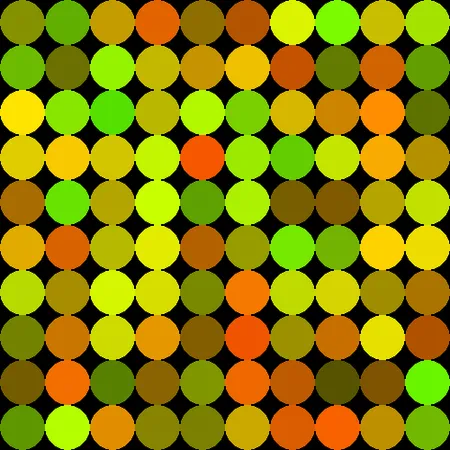
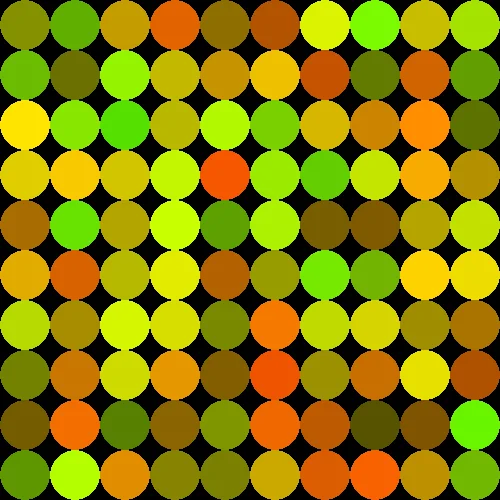
Ten rows of ten: one hundred discs, each touching its neighbours at exactly four points, north, south, east and west. This is square packing, and its signature is a single number. The circles cover π/4 of the plane, about 78.5 percent, and the black that remains is the 21.5 percent where the infinite slips through. The palette never leaves the warm band of the spectrum, yellow through orange through olive, a hundred variations on one frequency. The grid is order; the colour is chance. Between them: a field of sunflowers, seen by a mathematician.
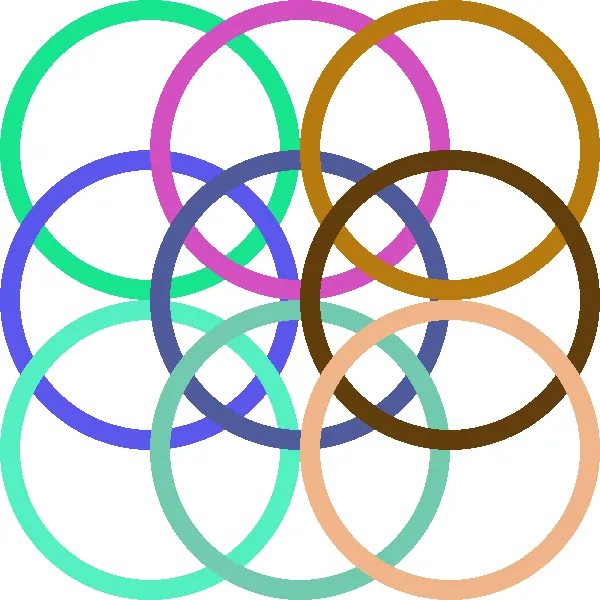
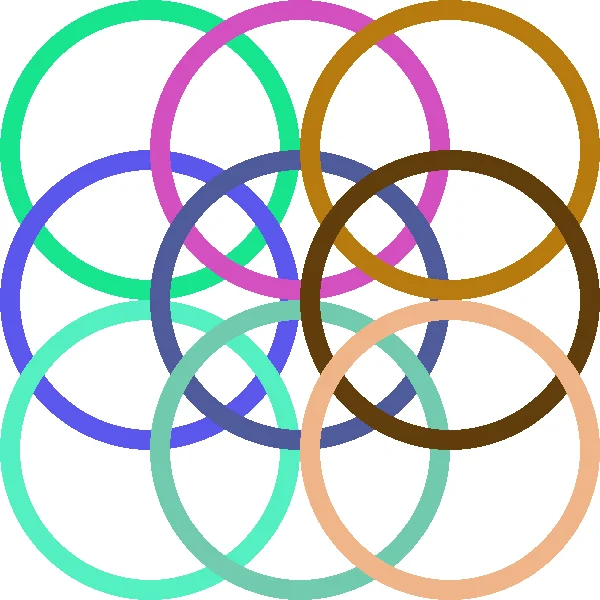
Nine rings that refuse to stay in their lanes. Their centres sit on a 3 × 3 lattice spaced closer than one diameter, so every ring cuts through its neighbours at two points, and between those points blooms a lens, the vesica piscis, drawn by geometers for millennia as the doorway where one world overlaps another. Follow the crossings and the nine become a single woven structure. No ring is complete on its own terms; each is defined as much by where it meets the others as by where it stands.
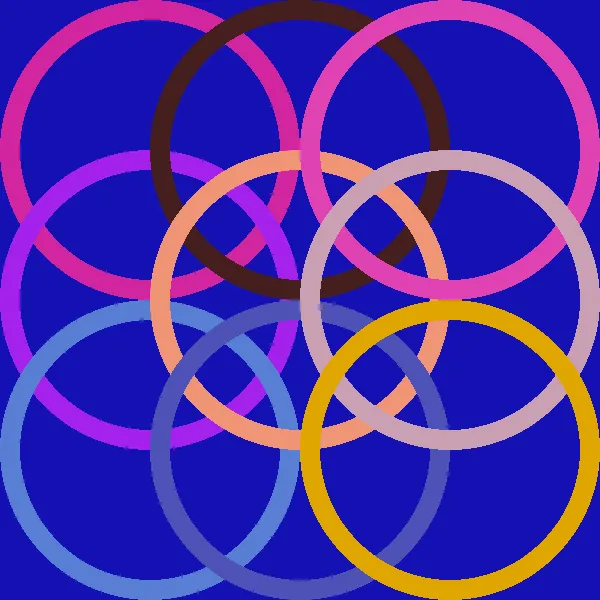
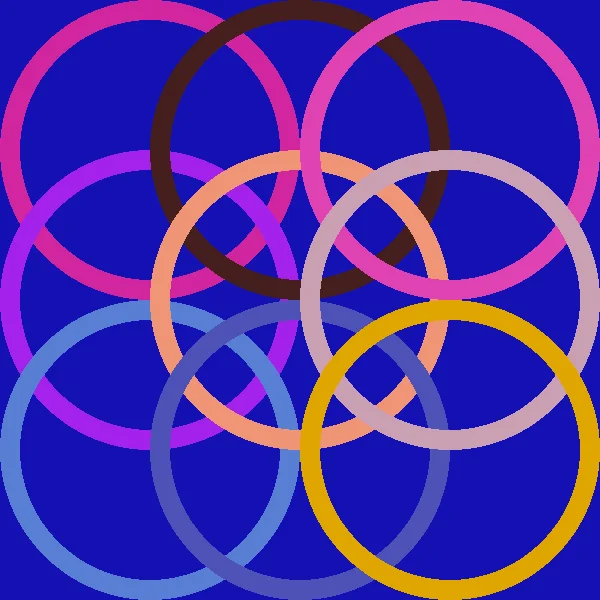
The same nine overlapping rings, now set against deep ultramarine, and suddenly they read as orbits rather than shapes. A circle is the path of a point held at a constant distance from a centre it never touches, which is the definition of a circle and a fair description of a planet. Where the rings cross, the colours weave over and under like a celestial braid. Euler’s identity, e^(iπ) + 1 = 0, ties the circle to the five most important numbers in mathematics. Here nine circles tie one another, and the blue holds them all.
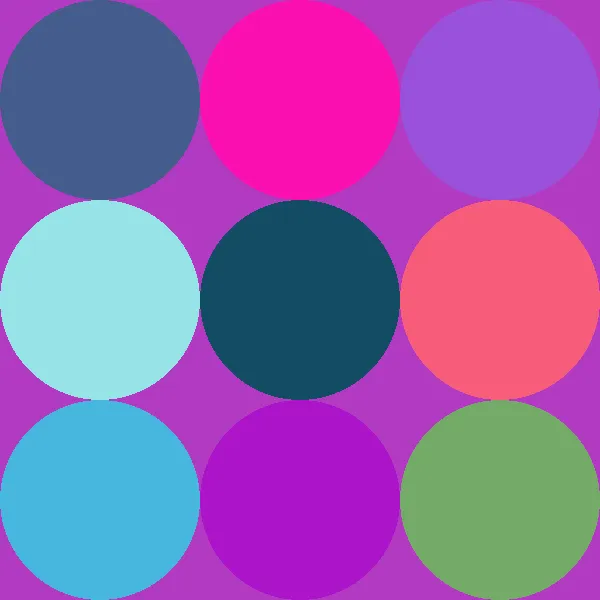
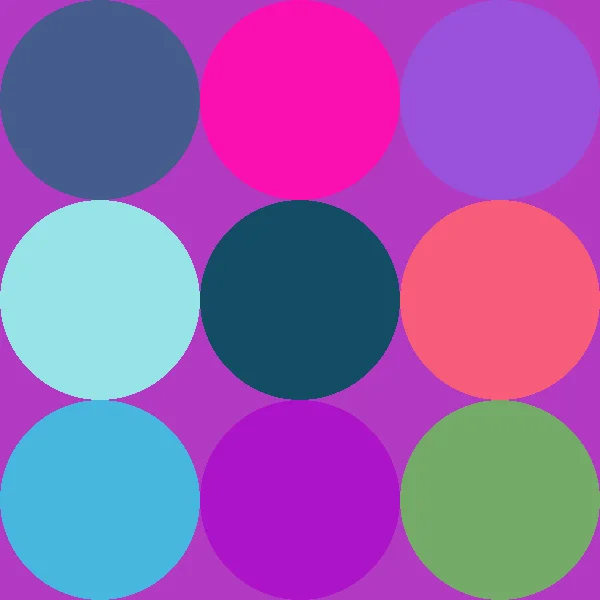
Nine solid discs, each exactly tangent to its neighbours, filling a violet square in three rows of three. Tangency is the most delicate relationship in geometry: two curves meeting at a single point, sharing one direction, crossing nothing. Every disc here kisses up to four others. And the colours are deliberately unrelated: slate, magenta, ice, teal, coral, sky, plum, sage. Nine individuals in perfect contact, none overlapping, none alone. If you wanted a diagram of a healthy community, it would be hard to draw a better one.
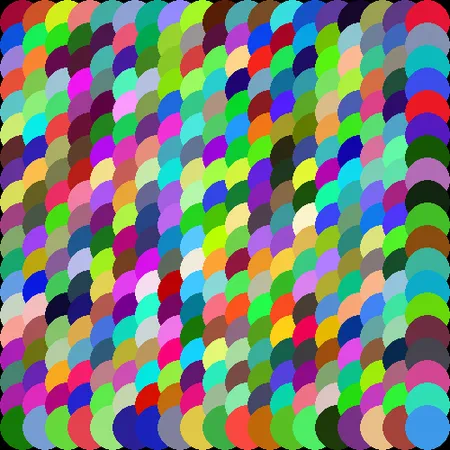
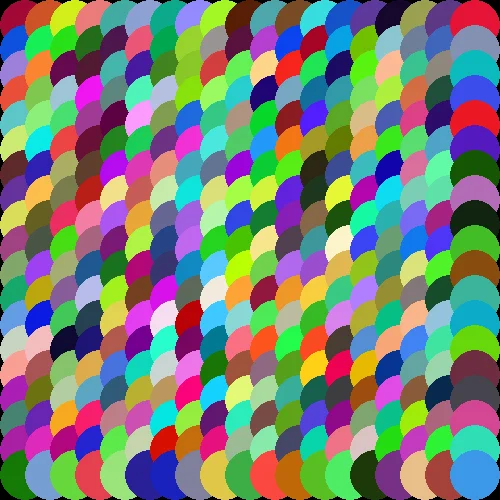
Here the discs overlap in offset rows like fish scales, or the seigaiha wave of Japanese pattern, each circle tucked beneath the next. The square grid of the other pieces has slid toward a hexagonal arrangement, and that matters: hexagonal packing is the densest way to arrange equal circles on a plane, covering π/(2√3), about 90.7 percent, as Axel Thue argued and László Fejes Tóth proved. Bees found it first in the honeycomb. With overlap, the coverage here becomes total. No black remains. The plane is completely, joyfully spent on colour.
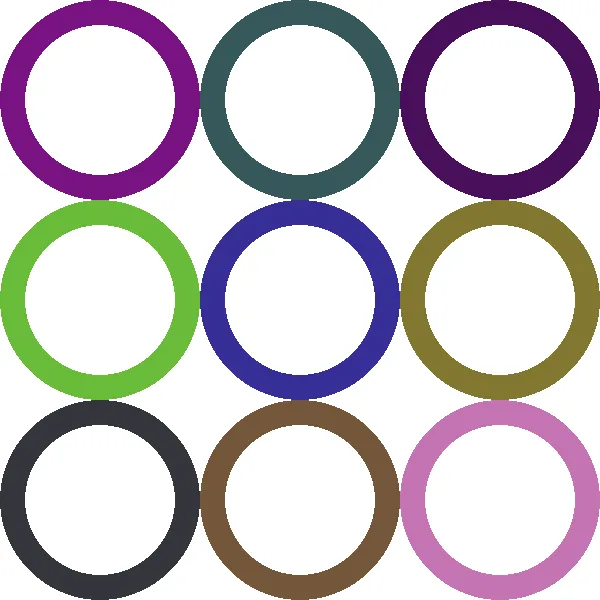
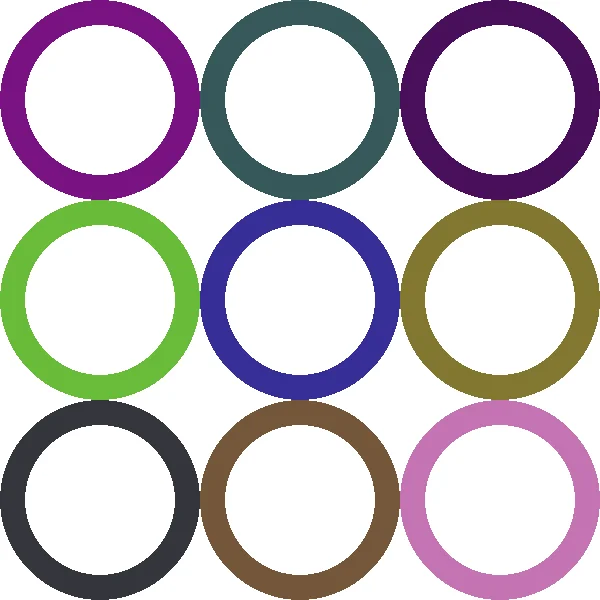
Nine annuli on white: rings bounded by two concentric circles, with air between them. The area of an annulus is π(R² − r²), and there is a lovely consequence. Draw a chord of the outer circle that just grazes the inner one, and its length alone tells you the ring’s area; the radii vanish from the calculation entirely. The white centres are not emptiness. They are the inner circle, the absent twin that gives every ring its form. Purple, slate, olive, plum: nine haloes with the saints stepped out.
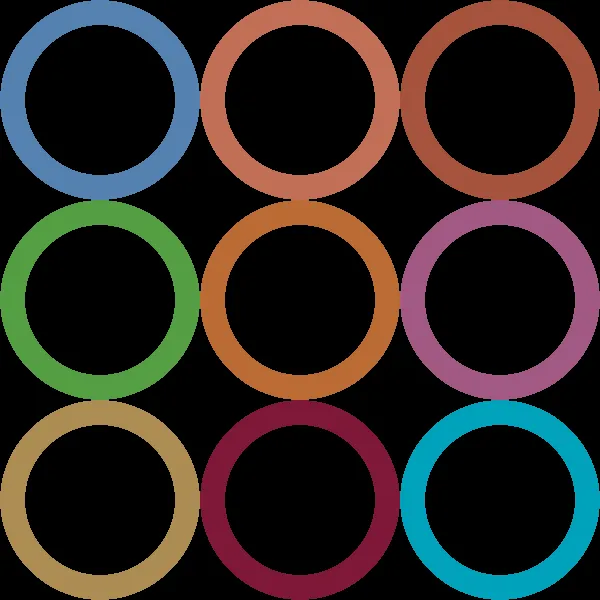
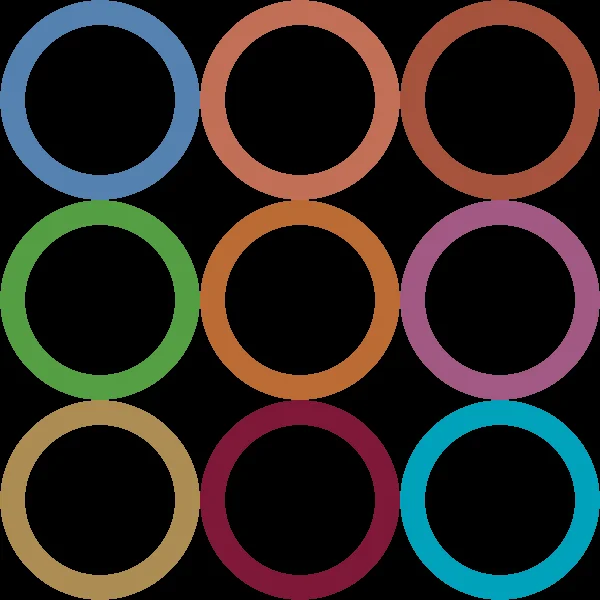
The same nine annuli, now on black, and now tangent, so the gaps between them become four-pointed stars of darkness, curved squares bounded by four quarter-arcs. Concentric means sharing a centre, and here every ring shares its centre with an inner circle of pure night, as if darkness were the core of every colour. Rust, sage, magenta, teal: warm and cool alternating with no rule I can find. Perhaps that is the rule. Balance does not require symmetry, only that every ring keeps hold of its own centre.
One orange circle on white, touching its frame at four points. After all the multitudes, the unit. The circle is the shape that encloses the most area for a given perimeter, the answer to the isoperimetric problem Queen Dido is said to have solved when she cut an oxhide into strips to enclose the land that became Carthage. Its curvature is the same everywhere, 1/r, the only closed curve with no favourite direction. It fills exactly π/4 of the square that holds it. A sun. A zero. A whole. Everything else in this collection is this, repeated.
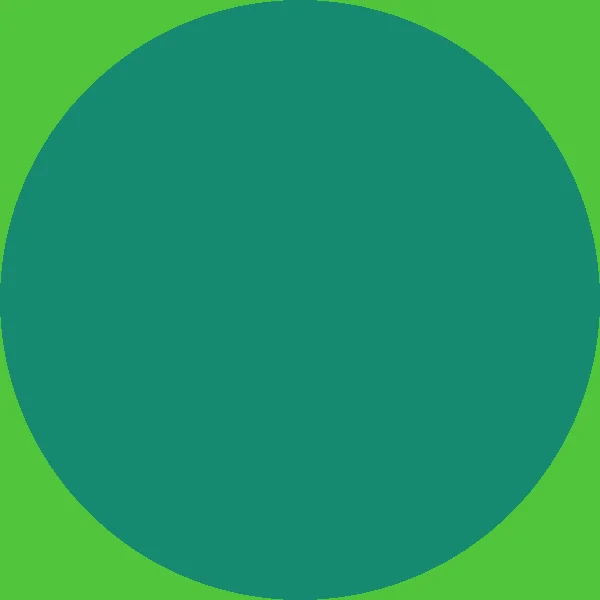
A teal disc on bright green: the lone circle again, but its colours are neighbours on the wheel, so the boundary nearly dissolves and you feel the shape before you see it. To a topologist the disc is the simplest bounded thing there is. It has no holes, and any loop drawn inside it can be pulled tight to a single point. Set it beside the orange circle and you have a pair, a binary: warm and cool, sun and water, one and zero. Every computer ever built is just these two circles, alternating very fast.
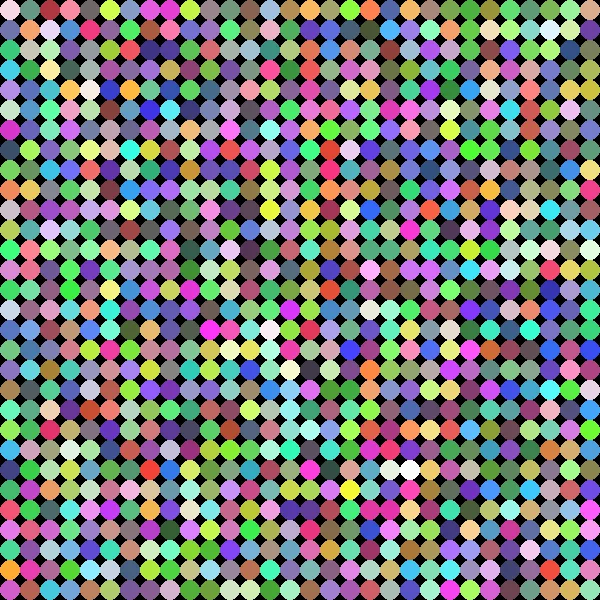
Hundreds of tiny dots in a tight square lattice, each colour seemingly drawn at random, like a cosmic census. Step back and the individual points dissolve into texture, the way pixels dissolve into a photograph and molecules into a smooth glass of water. This is the law of large numbers made visible. No single dot predicts its neighbour, yet the whole field settles into an even, shimmering calm. Chaos at the scale of one, order at the scale of many: a portrait of a population, and very nearly a portrait of the universe.
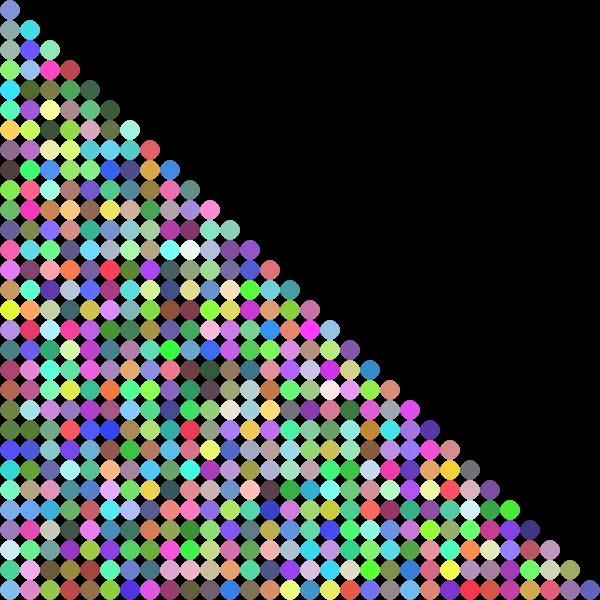
The same dense field of dots, sliced on the diagonal: a staircase of colour below, pure black above. Read it as rows and each row holds one more dot than the row before, so the running total follows the triangular numbers, n(n + 1)/2, the sum the young Gauss is said to have found in seconds by pairing the first number with the last. The Pythagoreans revered the tetractys, ten points in a triangle, as the shape of the cosmos. Here the triangle is enormous, and its diagonal edge is a straight line built entirely out of curves.
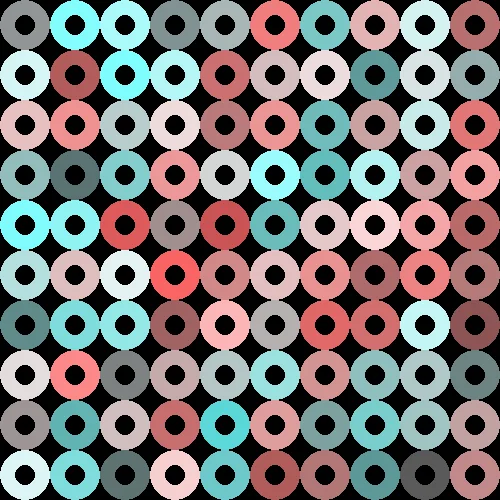
One hundred small rings, ten by ten, each a disc with a hole punched through its centre. That hole changes everything. To a topologist a ring and a disc are fundamentally different: a disc shrinks to a point, but a loop around the hole of a ring can never be pulled tight. Thicken the ring into three dimensions and you have a torus, the doughnut shape physicists use to sketch magnetic fields. A hundred tori in coral, ice and slate: a hundred tiny universes, each holding its emptiness at the centre.